

Most people don’t think about changing their tax structure until something starts to feel off. Usually it’s the tax bill. You finish a solid year, your business finally has momentum, and then you see how much is going out the door. That’s when Schedule C stops feeling simple and starts feeling expensive.
I’ve had this conversation hundreds of times with business owners. The question is always the same: when does it actually make sense to move from a Schedule C to an S Corporation? Not based on what someone said in a Facebook group, but based on real numbers.
Let’s walk through it the way it should be approached.
Schedule C is where you should start. It’s straightforward, easy to maintain, and gives you flexibility while you’re building. There’s nothing wrong with staying there in the early stages. In fact, trying to get fancy too early usually creates more problems than it solves.
But the downside is how the income is taxed. When you’re on Schedule C, every dollar of net profit is subject to self-employment tax. That’s 15.3 percent, before you even get into federal or state income taxes. At lower income levels, it’s manageable. As your income grows, that number starts to climb quickly.
There isn’t a single number where the switch suddenly becomes right, but there is a range where it starts to make sense to look at it seriously. In most cases, once a business is consistently netting somewhere in the neighborhood of sixty to seventy-five thousand dollars or more, it’s worth running the numbers. When you’re pushing into six figures, it becomes a much more important conversation.
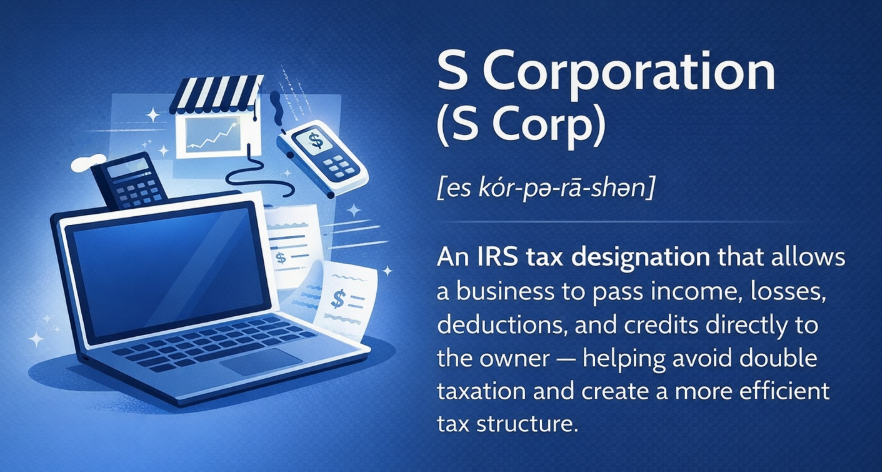
What changes with an S Corporation is not your business itself, but how the income is treated. Instead of everything being hit with self-employment tax, you split your income into two parts. One portion is paid to you as a salary, which is subject to payroll taxes. The rest comes through as distributions, which are not subject to that same self-employment tax.
That difference is where the savings come from.
Now, this is the part people tend to oversimplify. An S Corporation is not a loophole, and it’s not free money. There are additional responsibilities that come with it. You’re running payroll, filing a separate business return, issuing yourself a W-2, and generally keeping cleaner books. There are also higher accounting costs to do it correctly.
So the real question is not “can I elect S Corp status?” It’s “do the tax savings outweigh the added cost and complexity?”
At lower profit levels, they usually don’t. You might save a little on taxes, but it gets eaten up by payroll costs, filings, and administrative work. That’s why a lot of business owners who switch too early end up frustrated. They took on more complexity without a meaningful benefit.
On the other hand, once profits reach a certain level and stay there consistently, the math changes. The savings start to become noticeable, and then significant. That’s when it becomes a tool instead of a burden.
Consistency matters here more than anything. If your income swings wildly from year to year, it’s harder to justify the move. If your business is stable, predictable, and no longer in that early “figuring it out” phase, that’s when an S Corporation starts to fit.
There’s also one rule that can’t be ignored, and it’s where a lot of people get into trouble. You have to pay yourself a reasonable salary. The IRS expects that if you’re actively working in the business, you’re paying yourself something that reflects the work you’re doing.
You can’t just take a minimal salary and call everything else a distribution to avoid taxes. That’s the kind of thing that raises flags. At the same time, if your salary is too high, you’re defeating the purpose of the structure. Finding that balance is where experience actually matters.
The way I explain it to clients is simple. Schedule C is a great place to start, but it’s not always the best place to stay once the business matures. Moving to an S Corporation isn’t about being clever with taxes. It’s about aligning your structure with the level your business has reached.
If your business is still in the early stages, still growing, or not consistently profitable, keep it simple. Focus on building. But if you’ve reached a point where the income is steady and the tax bill is starting to feel out of proportion, it’s time to take a closer look.
The right answer always comes down to your numbers. Not a rule of thumb, not something you heard online, but your actual situation.
And when you run those numbers correctly, the decision usually becomes pretty clear.
Leave a Reply
Want to join the discussion?Feel free to contribute!