If you’ve been self-employed for any length of time, you’ve probably had the same thought at least once: “What am I doing for retirement?” It’s easy to put it off. When you’re running your own business, cash flow, taxes, payroll, and growth always feel more urgent than something 20 or 30 years down the road. I’ve seen it countless times over the past two decades. Smart, hardworking business owners making great money, but with very little set aside for the future.

The good news is that self-employed retirement plans are not only flexible, they can be extremely powerful if you use them correctly. In many cases, they’re actually better than what traditional employees get through a typical 401(k). The challenge is understanding your options and choosing the one that fits how your business operates.

Let’s start with the mindset shift. When you work for yourself, no one is setting up your retirement for you. There’s no HR department enrolling you automatically, no employer match coming in the background. You are both the employee and the employer. That means you get more control, but also more responsibility. Once you accept that, the rest starts to fall into place.

One of the simplest and most common plans I recommend is a SEP IRA. This is usually where I start with clients who are either just getting serious about retirement or want something easy to manage. A SEP IRA allows you to contribute as the employer, which in this case is you. The contribution limits are generous compared to traditional IRAs, and the setup is straightforward. There’s no complicated annual filing requirement, and most custodians make it easy to open and fund.

The real advantage of a SEP IRA is flexibility. If you have a great year, you can contribute a larger amount. If cash flow is tight, you can scale it back or skip a contribution altogether. That kind of flexibility matters when your income isn’t perfectly predictable. I’ve had clients who use SEP IRAs almost like a year-end tax planning tool. Once we see where their numbers land, we can decide how much to contribute to reduce taxable income.

That said, SEP IRAs are not always the best fit, especially as your income grows or if you want to maximize contributions more aggressively. That’s where a Solo 401(k) comes into play. This is one of the most powerful retirement tools available to self-employed individuals, and it’s often underutilized simply because people don’t realize how much they can put away.

With a Solo 401(k), you wear two hats. As the employee, you can defer a portion of your income. As the employer, you can also make a profit-sharing contribution. When you combine those two, the total contribution limit can be significantly higher than what you can do with a SEP IRA, especially at certain income levels.

Another benefit of a Solo 401(k) is the option for Roth contributions on the employee side. This gives you some tax diversification. Instead of everything being pre-tax, you can build a portion of your retirement savings that grows tax-free. Over the long term, that can make a meaningful difference depending on how tax rates change and what your retirement income looks like.

There is a little more administration involved with a Solo 401(k), particularly once the balance reaches certain thresholds, but in my experience, the extra effort is worth it for many business owners. If you’re consistently generating strong income, this is often the plan that gives you the most leverage.

Then there’s the SIMPLE IRA, which tends to fall somewhere in between. I don’t recommend it as often for solo operators, but it can make sense if you have a small team and want a retirement plan that’s easy to implement without the complexity of a full 401(k) plan. The contribution limits are lower than a Solo 401(k), but it still provides a structured way to save and offer benefits to employees.

Now let’s talk about something that doesn’t get enough attention. Timing and consistency matter more than perfection. I’ve worked with business owners who spent years trying to decide on the “best” plan and ended up doing nothing. Meanwhile, others picked a solid option and contributed consistently, even if it wasn’t optimized from day one. Guess who ends up in a better position over time.

You don’t need to get everything perfect right away. You need to start. Once you have a plan in place, you can adjust as your business evolves. Your income will change, your goals will shift, and tax laws will move. That’s normal. Retirement planning for a self-employed person is not a one-time decision. It’s something you revisit regularly.

Another piece that often gets overlooked is how retirement contributions tie into your overall tax strategy. This is where experience really matters. Contributions to plans like SEP IRAs and Solo 401(k)s can significantly reduce your taxable income. That can help you manage your tax bracket, reduce self-employment tax exposure in certain cases, and create more predictable outcomes when we’re planning at year-end.

I’ve had plenty of conversations where a client thought they were going to owe a large tax bill, and we were able to soften that impact by making a strategic retirement contribution. On the flip side, I’ve also seen people miss that opportunity because they waited too long or didn’t have a plan in place.

One thing I always stress is cash flow. Retirement contributions are powerful, but they shouldn’t put your business in a tight spot. You still need working capital. You still need reserves. The goal is to strike a balance between building for the future and keeping your current operation healthy. That balance looks different for everyone.

If your income is more volatile, you might lean toward a SEP IRA for flexibility. If your income is stable and strong, a Solo 401(k) might allow you to push more into retirement each year. If you’re growing a team, you might look at options that include employee benefits. There’s no one-size-fits-all answer, and anyone telling you there is probably hasn’t spent enough time in the real world with business owners.

Let’s also address the elephant in the room. A lot of self-employed individuals assume they’ll just sell their business and use that as their retirement plan. That can work, but it’s risky to rely on it entirely. Markets change, industries shift, and not every business sells for what the owner expects. I’ve seen people build great companies and still struggle to convert that into a clean exit.

Think of your retirement plan as a separate pillar. Your business can absolutely be part of your long-term strategy, but it shouldn’t be the only piece. Having dedicated retirement savings gives you options. It gives you flexibility if you decide to slow down, pivot, or step away sooner than expected.

Another practical point is keeping things organized. If you set up a retirement plan, make sure contributions are tracked properly, deadlines are met, and everything is reported correctly on your tax return. This sounds basic, but mistakes here can create headaches. I’ve seen missed deductions, incorrect filings, and contributions made outside the allowable window. Those are avoidable issues with the right guidance.

At the end of the day, self-employed retirement planning comes down to being intentional. You’ve already taken control of your income by working for yourself. This is just the next step in taking control of your future.

If you’re not sure where to start, start with a conversation. Look at your income, your business structure, your goals, and your timeline. From there, it becomes much clearer which plan makes sense and how much you should be putting away each year.

After more than 20 years in this field, I can tell you the people who take this seriously early on are almost always glad they did. And the ones who wait usually wish they hadn’t. The gap between those two outcomes isn’t luck. It’s just a matter of making a decision and sticking with it.

Most people don’t think about changing their tax structure until something starts to feel off. Usually it’s the tax bill. You finish a solid year, your business finally has momentum, and then you see how much is going out the door. That’s when Schedule C stops feeling simple and starts feeling expensive.

I’ve had this conversation hundreds of times with business owners. The question is always the same: when does it actually make sense to move from a Schedule C to an S Corporation? Not based on what someone said in a Facebook group, but based on real numbers.

Let’s walk through it the way it should be approached.

Schedule C is where you should start. It’s straightforward, easy to maintain, and gives you flexibility while you’re building. There’s nothing wrong with staying there in the early stages. In fact, trying to get fancy too early usually creates more problems than it solves.

But the downside is how the income is taxed. When you’re on Schedule C, every dollar of net profit is subject to self-employment tax. That’s 15.3 percent, before you even get into federal or state income taxes. At lower income levels, it’s manageable. As your income grows, that number starts to climb quickly.

There isn’t a single number where the switch suddenly becomes right, but there is a range where it starts to make sense to look at it seriously. In most cases, once a business is consistently netting somewhere in the neighborhood of sixty to seventy-five thousand dollars or more, it’s worth running the numbers. When you’re pushing into six figures, it becomes a much more important conversation.

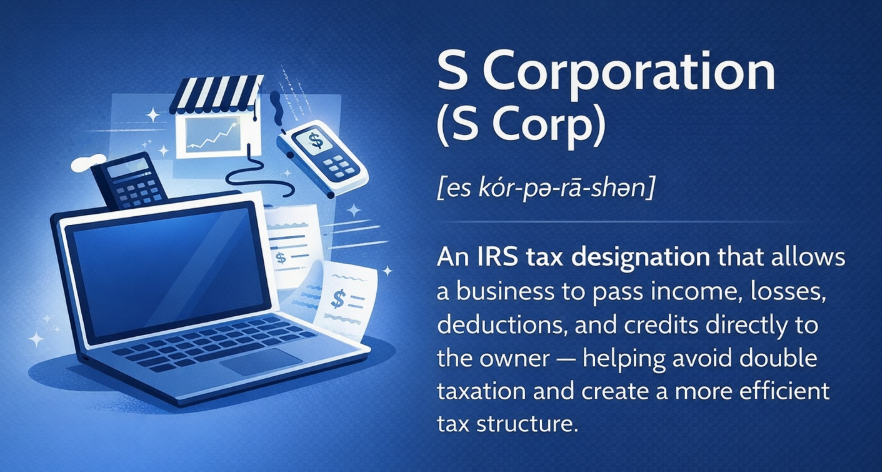
What changes with an S Corporation is not your business itself, but how the income is treated. Instead of everything being hit with self-employment tax, you split your income into two parts. One portion is paid to you as a salary, which is subject to payroll taxes. The rest comes through as distributions, which are not subject to that same self-employment tax.

That difference is where the savings come from.

Now, this is the part people tend to oversimplify. An S Corporation is not a loophole, and it’s not free money. There are additional responsibilities that come with it. You’re running payroll, filing a separate business return, issuing yourself a W-2, and generally keeping cleaner books. There are also higher accounting costs to do it correctly.

So the real question is not “can I elect S Corp status?” It’s “do the tax savings outweigh the added cost and complexity?”

At lower profit levels, they usually don’t. You might save a little on taxes, but it gets eaten up by payroll costs, filings, and administrative work. That’s why a lot of business owners who switch too early end up frustrated. They took on more complexity without a meaningful benefit.

On the other hand, once profits reach a certain level and stay there consistently, the math changes. The savings start to become noticeable, and then significant. That’s when it becomes a tool instead of a burden.

Consistency matters here more than anything. If your income swings wildly from year to year, it’s harder to justify the move. If your business is stable, predictable, and no longer in that early “figuring it out” phase, that’s when an S Corporation starts to fit.

There’s also one rule that can’t be ignored, and it’s where a lot of people get into trouble. You have to pay yourself a reasonable salary. The IRS expects that if you’re actively working in the business, you’re paying yourself something that reflects the work you’re doing.

You can’t just take a minimal salary and call everything else a distribution to avoid taxes. That’s the kind of thing that raises flags. At the same time, if your salary is too high, you’re defeating the purpose of the structure. Finding that balance is where experience actually matters.

The way I explain it to clients is simple. Schedule C is a great place to start, but it’s not always the best place to stay once the business matures. Moving to an S Corporation isn’t about being clever with taxes. It’s about aligning your structure with the level your business has reached.

If your business is still in the early stages, still growing, or not consistently profitable, keep it simple. Focus on building. But if you’ve reached a point where the income is steady and the tax bill is starting to feel out of proportion, it’s time to take a closer look.

The right answer always comes down to your numbers. Not a rule of thumb, not something you heard online, but your actual situation.

And when you run those numbers correctly, the decision usually becomes pretty clear.